Rotational Motion - The physics of Objects in Circular Motions
Unit 3: Rotational Motion
Moving in Circles
When an object moves in a uniform circular motion, that means it is traveling in a circular path at a constant speed. The object direction changes as it goes in circles instead of traveling in a straigth line due to an acceleration perpendicular to its velocity. This is what we call centripetal acceleration - Ac .
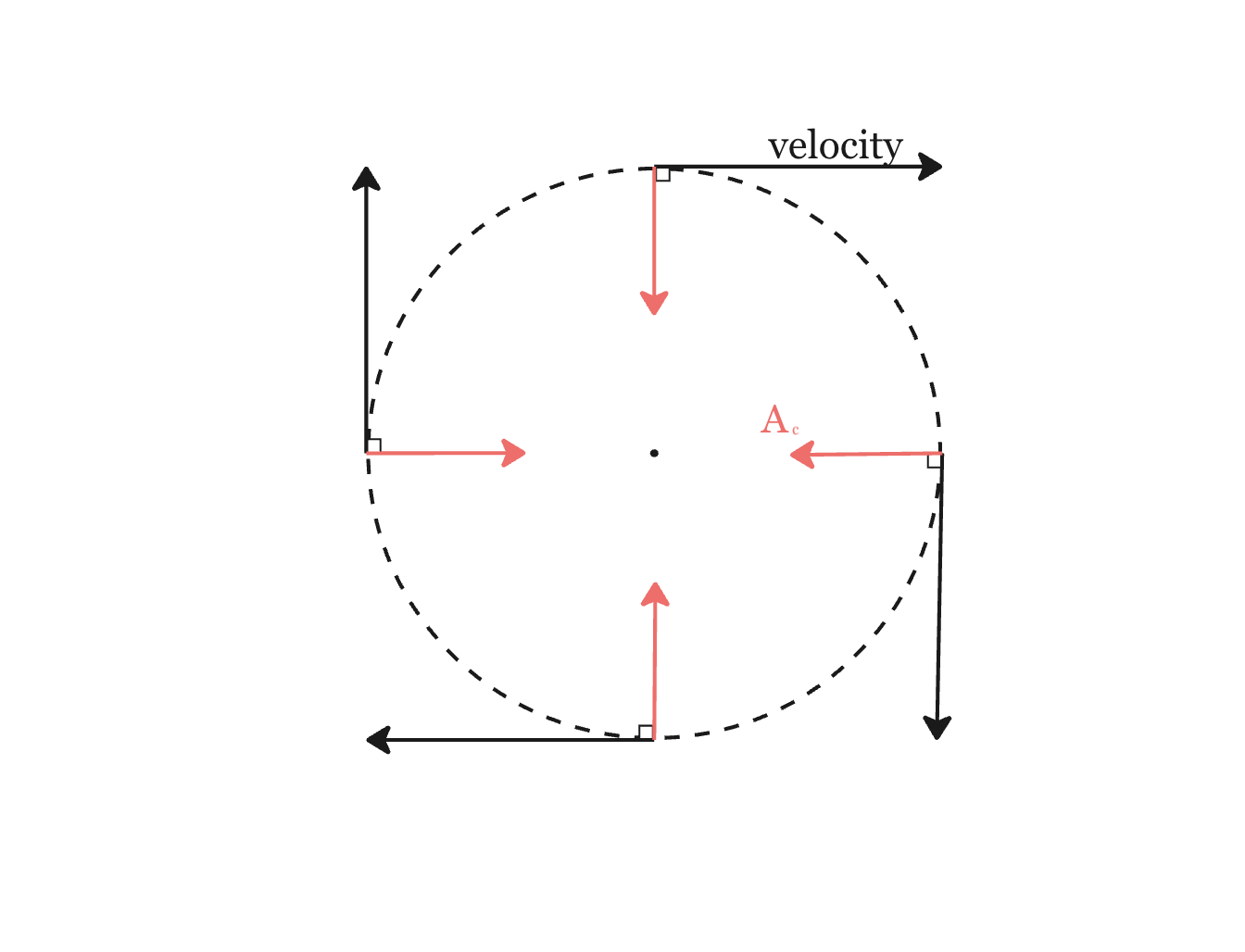
Centripetal acceleration is always directed towards the center of the circle and is given by the formula:
\( A_c = \frac{v^2}{r} \)
Where:
- \( A_c \) is the centripetal acceleration
- \( v \) is the linear speed of the object
- \( r \) is the radius of the circular path
Centripetal Force - Fc
We know that when there is an acceleration, there is also a force. In this case of circular motion, the force is Centripetal Force, and this force also points towards the center of the circle. Centripetal force is an important concept as it helps us understand and calculation how fast an object is moving in a circle, how big of a circle it is going around, or how much the object traveling weighs. A great example of this is planets orbiting each other, where the centripetal force is gravity which keeps the plants going in circles around the sun. The equation for centripetal force is:
\( F_c = m \frac{v^2}{r} \)
Where:
- \( F_c \) is the centripetal force
- \( m \) is the mass of the object
- \( v \) is the linear speed of the object
- \( r \) is the radius of the circular path
_________________________________________________________________________________________________________
Examples of Centripetal force
Car going around a curve:
A common example you can think of for centripetal force is going around a curve in a car, more clearly, a roundabout. The reason that the car is able to go in a circle is because of friction between the tires and the road, which provides a force toward the inner circle and allows you to go in a circle. If there was no friction, you would continue straight even if you turned your wheels. Think about a car turning on ice, even if they turn the wheels, they won't be able to turn around or go in a circle because there is no friction to act as a Fc.
Planetary Orbits:
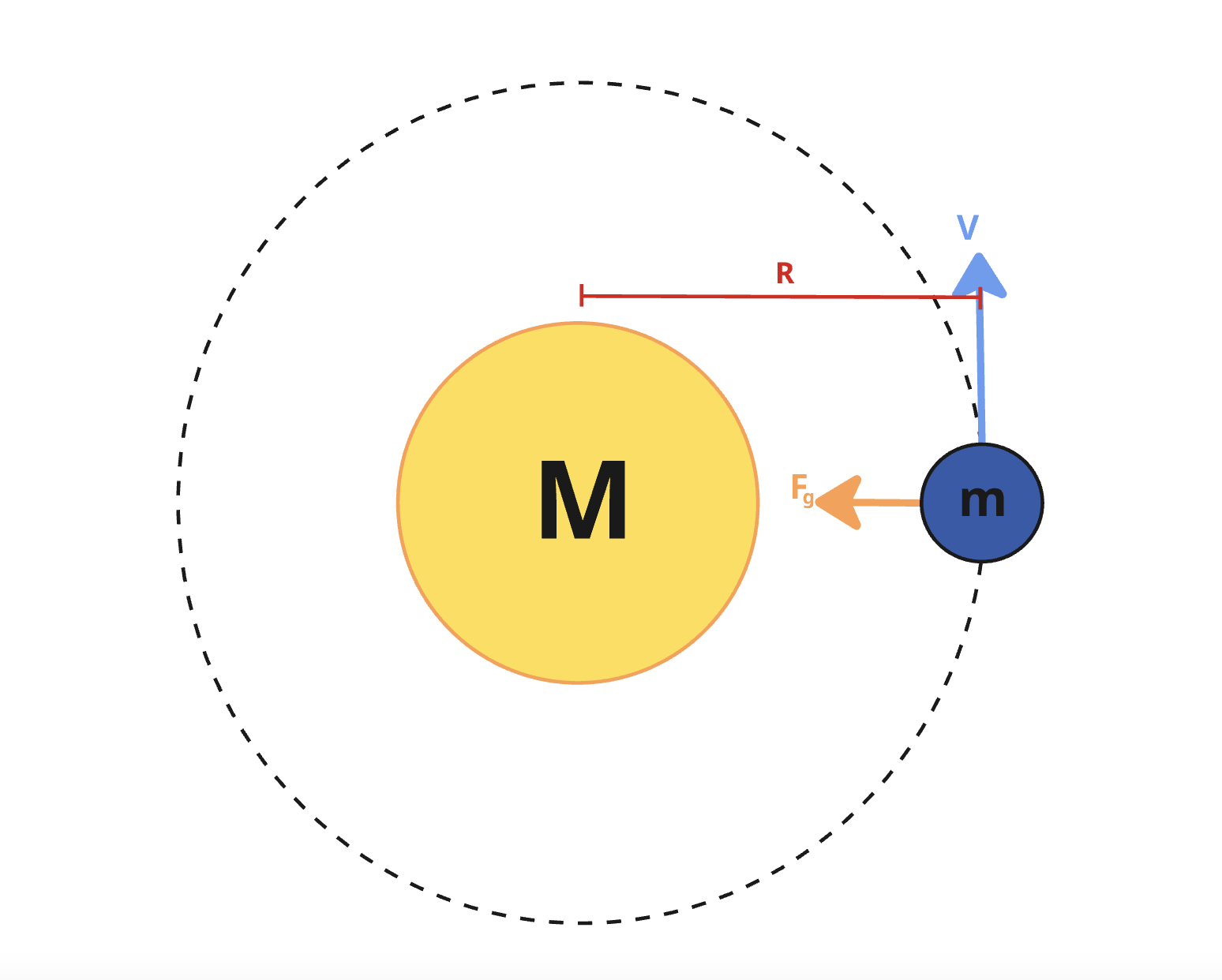
An example of centripetal force in planetary orbits is the gravitational force between a planet and the sun. This gravitational force acts as the centripetal force, pulling the planet toward the sun and keeping it in a circular orbit. The planet's inertia tries to move it in a straight line, but the gravitational pull constantly changes its direction, resulting in orbital motion.
Spinning object on a string:
An example of centripetal force in this scenario is the tension in the string, which provides the centripetal force necessary to keep the object moving in a circular path. The tension acts towards the center of the circle, changing the direction of the object's velocity and maintaining its circular motion.
_________________________________________________________________________________________________________
Law of Universal Gravitation
Newtons Law of Universal Gravitation states that every particle in the universe attracts every other particle with a force proportional to the product of their masses and
inversely proportional to the square of the distance between them.
This is force that attract planets like earth to the sun, and that force is the centripetal force that keep us moving in an elliptical orbit around the sun.
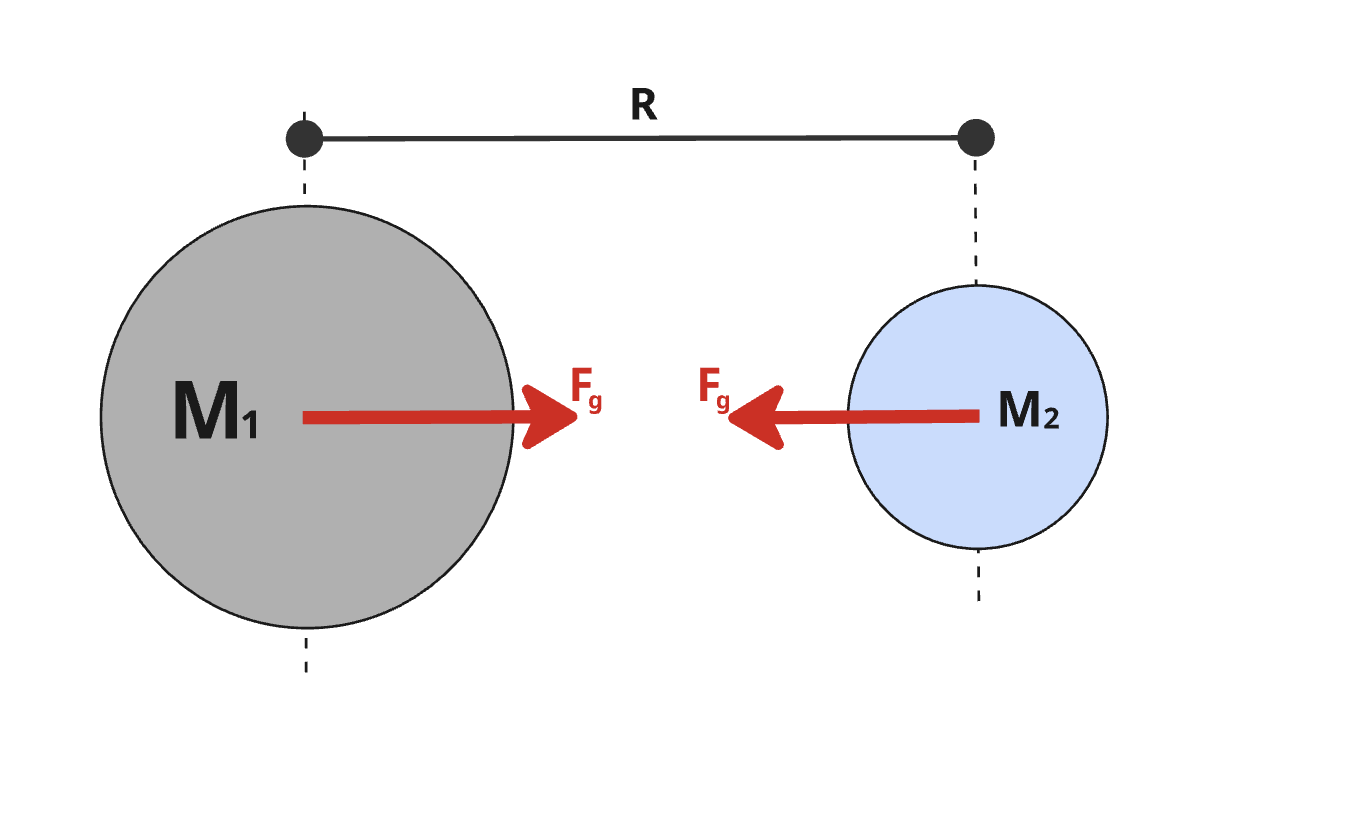
\( F_g = G \frac{M_1 m_2}{r^2} \)
Where:
- \( F_g \) is the gravitational force between the two masses
- \( G \) is the gravitational constant (approximately \( 6.674 \times 10^{-11} \, \text{N} \cdot \text{m}^2/\text{kg}^2 \))
- \( m_1 \) and \( m_2 \) are the masses of the two objects
- \( r \) is the distance between the centers of the two masses
Kepler's Laws of Planetary Motion
Kepler's First Law: each planet's orbit about the Sun is an ellipse. The Sun's center is always located at one focus of the orbital ellipse. The Sun is at one focus. The planet follows the ellipse in its orbit, meaning that the planet to Sun distance is constantly changing as the planet goes around its orbit.
Kepler's Second Law: the imaginary line joining a planet and the Sun sweeps equal areas of space during equal time intervals as the planet orbits. Basically, that planets do not move with constant speed along their orbits. Rather, their speed varies so that the line joining the centers of the Sun and the planet sweeps out equal parts of an area in equal times. The point of nearest approach of the planet to the Sun is termed perihelion. The point of greatest separation is aphelion, hence by Kepler's Second Law, a planet is moving fastest when it is at perihelion and slowest at aphelion.
Kepler's Third Law: The ratio of the squares of the period of any two object or planets about another object in space, like the sun, is equal to the cubes of their average distances from the Sun. The equation for Kepler's Third Law is:
\( \frac{T_1^2}{T_2^2} = \frac{r_1^3}{r_2^3} \)
Where:
- \( T_1 \) and \( T_2 \) are the orbital periods of the two planets
- \( r_1 \) and \( r_2 \) are the average distances of the two planets from the Sun
What is this useful for? Kepler's law in ratio form allows us to determine how an object will orbit the sun based on knowing how another object orbits the sun. We use the equation to compare their ratios and solve for either the radius or orbital period of a object in space about the sun
Lastly using what we have learned so far, we can use these equations to derive the orbital period of an object around a planet. Knowing how to derive Kepler's equation can be useful, though it is not very complicated. To see how to derive it step by step click here: Deriving a Planets Period
Practice Problems:
Multiple Choice
-
A car moves at constant speed around a flat circular track. Which of the following best explains why the car is accelerating?
A) The car is accelerating because its speed is increasing
B) The car is accelerating because its velocity is changing direction
C) The car is not accelerating because its speed is constant
D) The car is not accelerating because the net force is zero -
A ball on a string moves in a horizontal circle at constant speed. Which of the following correctly identifies the direction of the net force on the ball?
A) Tangent to the circle in the direction of motion
B) Tangent to the circle opposite the direction of motion
C) Toward the center of the circle
D) Away from the center of the circle -
A satellite is moved from one circular orbit around a planet to another circular orbit with twice the radius. How does the gravitational force exerted on the satellite change?
A) It doubles
B) It becomes four times as large
C) It becomes one-half as large
D) It becomes one-fourth as large -
Two planets orbit the same star. Planet X is farther from the star than Planet Y. Which statement is correct?
A) Planet X has the greater orbital speed
B) Planet X has the smaller orbital period
C) Planet X has the smaller orbital speed
D) Planet X and Planet Y have the same orbital speed -
A planet moves in an elliptical orbit around its star. At which point is the planet's speed greatest?
A) When the planet is closest to the star
B) When the planet is farthest from the star
C) The speed is constant throughout the orbit
D) The speed depends only on the planet's mass -
A student claims that an object moving in a circle at constant speed is in equilibrium because the speed does not change. Which of the following is the best response?
A) The student is correct because constant speed means zero acceleration
B) The student is correct because the forces cancel in circular motion
C) The student is incorrect because the object has centripetal acceleration caused by a net inward force
D) The student is incorrect because circular motion always requires an outward net force
Free Response
-
A 1200 kg car travels at 18 m/s around a circular curve of radius 45 m.
A. Calculate the centripetal acceleration of the car.
B. Calculate the net force acting on the car.
C. State the direction of the net force. -
A 0.80 kg ball is tied to a string and swung in a horizontal circle of radius 1.6 m at a speed of 5.0 m/s.
A. Calculate the centripetal force on the ball.
B. If the speed is doubled while the radius remains the same, determine the new centripetal force.
C. Explain why the force changes by that amount. -
Two objects with masses \(4.0 \times 10^3\) kg and \(6.0 \times 10^3\) kg are separated by 12 m.
A. Calculate the gravitational force between the objects.
B. If the distance between the objects is doubled, determine the new gravitational force.
C. Explain your reasoning using the relevant proportional relationship. -
Satellite A orbits a planet in a circular orbit of radius \(1.5 \times 10^6\) m with an orbital period of 500 days.
Satellite B orbits the same planet at a radius of \(7.6 \times 10^6\) m.
Use Kepler’s Third Law to determine the orbital period of Satellite B. -
Planet X orbits a star in 8 years. Planet Y orbits the same star at an average orbital radius 4 times greater than that of Planet X.
A. Determine the orbital period of Planet Y.
B. Explain why the period increases so much even though the radius only increases by a factor of 4. -
A satellite moves in a circular orbit around Earth. A student says, “Because the satellite’s speed is constant, there is no net force acting on it.”
Write a brief paragraph explaining why this statement is incorrect. Your response should reference velocity, acceleration, and force. -
A planet moves around a star in an elliptical orbit.
A. State Kepler’s Second Law in words.
B. Based on this law, explain why the planet moves faster when it is closer to the star.