Kinematics - The branch of physics that describes the motion of objects.
UNIT 1 Kinematics:
This unit of physics talks about the fundamental concepts for the movement of objects, including position, distance, displacement, speed, velocity, time, and acceleration. During unit 1, you will learn the 3 kinematic equations, allowing you to solve for an object's initial velocity, final velocity, displacement, acceleration, and time. You will also learn how to read and determine unknown variables from graphs: position vs. time, velocity vs. time, and acceleration vs. time. Lastly, you will learn about objects in projectile motion and free fall.
Terms:
(d) Distance — distance is a scalar quantity that measures the total length of an object's path regardless of the starting and end points. Distance is measured in meters, and CANNOT be negative because it is scalar.
(∆x) Displacement — displacement is a vector quantity (meaning it has both magnitude and direction) that measures the difference between the initial and final location of an object. Displacement is measured in meters and can be negative because it's a vector quantity.
\[ \Delta x = x - x_0 \]
where \(\Delta x\) = displacement, \(x\) = final position, \(x_0\) = initial position
(s) Speed — speed is a scalar quantity and is the rate at which an object changes its position. It is the rate of distance per time. Speed is measured in meters per second (m/s), and CANNOT be negative because it is scalar.
\[ s = \frac{d}{\Delta t} \]
where \(s\) = speed, \(d\) = distance, \(\Delta t\) = time interval
(v) Velocity — velocity is a vector quantity, which is the rate position changes with time. The difference between speed and velocity is that velocity is displacement over time, not distance. Displacement is measured in meters per second and can be negative because it is a vector quantity.
\[ v = \frac{\Delta x}{\Delta t} \]
where \(v\) = velocity, \(\Delta x\) = displacement, \(\Delta t\) = time interval
(a) Acceleration — acceleration is a vector quantity and is the rate at which velocity changes with time. Acceleration measures how quickly an object's speed or velocity is changing over time. It tells you how rapidly velocity changes and in what direction. Acceleration is measured in meters per second squared and can be negative because it is a vector quantity.
\[ a = \frac{\Delta v}{\Delta t} = \frac{v_x - v_0}{\Delta t} \]
where \(a\) = acceleration, \(\Delta v\) = change in velocity, \(\Delta t\) = time interval, \(v_x\) = final velocity, \(v_0\) = initial velocity
The Three Kinematic Equations:
-
\[ v_x = v_{x0} + a_x t \]
where \(v_x\) = final velocity, \(v_{x0}\) = initial velocity, \(a_x\) = acceleration, \(t\) = time
-
\[ x = x_0 + v_{x0}\,t + \tfrac{1}{2}a_x t^2 \]
where \(x\) = final position, \(x_0\) = initial position, \(v_{x0}\) = initial velocity, \(a_x\) = acceleration, \(t\) = time
-
\[ v_x^2 = v_{x0}^2 + 2a_x(x - x_0) \]
where \(v_x\) = final velocity, \(v_{x0}\) = initial velocity, \(a_x\) = acceleration, \(x\) = final position, \(x_0\) = initial position
Graphs:
Graphs are an important tool in physics used to organize and analyze data while providing a visual relationship between two quantities. Graphs tend to show the relationship between a dependent variable (y-axis) and an independent variable (x-axis). The three important graphs learned in kinematics are position vs. time, velocity vs. time, and acceleration vs. time.
Position vs. Time (x vs. time)
On a position vs. time graph, the value on the graph gives the position at a point in time. The y-axis is position (x) measured in meters, and the x-axis is time measured in seconds. The slope of a position vs. time graph gives the velocity of an object, because slope is y/x, which is meters/second in this case. When the slope of a position vs. time graph is constant, the velocity is constant, so there is no acceleration. When the slope is zero, there is no velocity because the position remains the same over time. However, when the slope of a position graph curves positively, there is positive acceleration because the slope is increasing. When the slope curves negatively, there is negative acceleration because the slope is negatively increasing.
Velocity vs. Time (v vs. time)
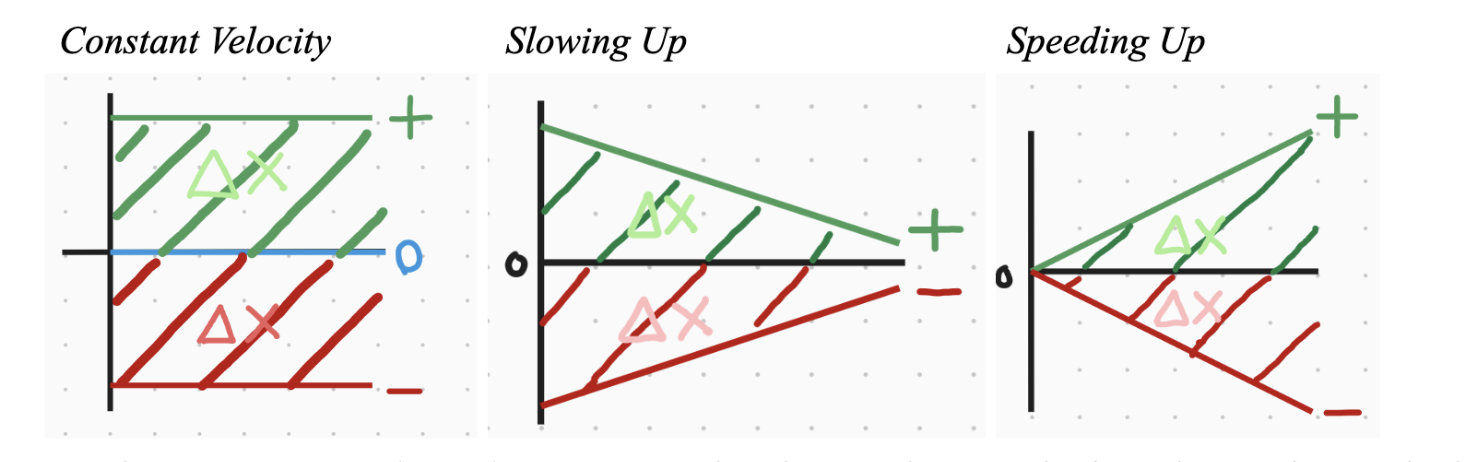
On a velocity vs. time graph, the value on the graph gives the velocity of an object at a point in time. The y-axis is velocity (v) measured in meters per second, and the x-axis is time measured in seconds. The slope of a velocity vs. time graph gives the acceleration of an object because the slope in this case would be meters/seconds/seconds, which translates to meters/second squared. When the slope of a velocity vs. time graph is constant, the acceleration is constant because acceleration is the slope. When the slope is zero, there is no acceleration because the velocity is remaining the same over time. However, when the slope is curving positively, the acceleration is positively increasing, because the slope is increasing. When the slope is curving negatively, the acceleration is negatively increasing because the slope is negatively increasing. Lastly, the area underneath a velocity vs. time graph is equal to the displacement of an object because the area under the curve is equal to the value of the y-axis (m/s) times the x-axis (seconds). Therefore, when these two multiply, you are left with ms/s, where the seconds cancel and you are left with just meters.

Acceleration vs. Time (a vs. t)
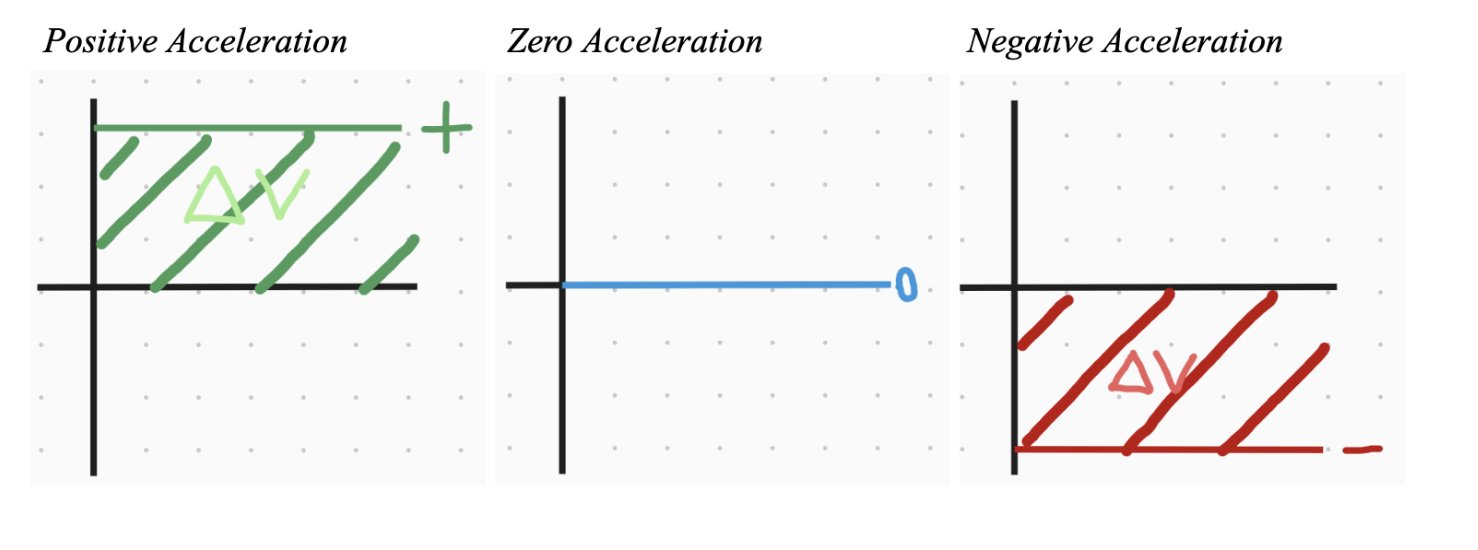
On an acceleration vs. time graph, the value on the graph gives the acceleration of an object at a point in time. The y-axis is acceleration measured in meters per second squared, and the x-axis is time measured in seconds. The slope is equal to jerk, which is the rate of change of acceleration over time; however, jerk is rarely talked about in AP Physics 1, so you don't need to worry about it. If the slope is zero, then the acceleration is constant because it is not changing over time, and if the line is below the x-axis, then the acceleration of the object is negative because the values of acceleration are negative below the x-axis. The most important thing about acceleration vs. time graphs is what is under the line or curve. The area under the line or curve on an acceleration vs. time graph is equal to ∆v (vx-vi), which is the change in velocity. This is because the area under the curve is equal to the value of the y-axis (m/s2) times the x-axis (seconds). Therefore, when these two multiply, you are left with m/s2/s, where the seconds cancel and you are left with m/s, which is equal to velocity.
*Important to Know These Relationships About Acceleration and Velocity
Projectile Motion:
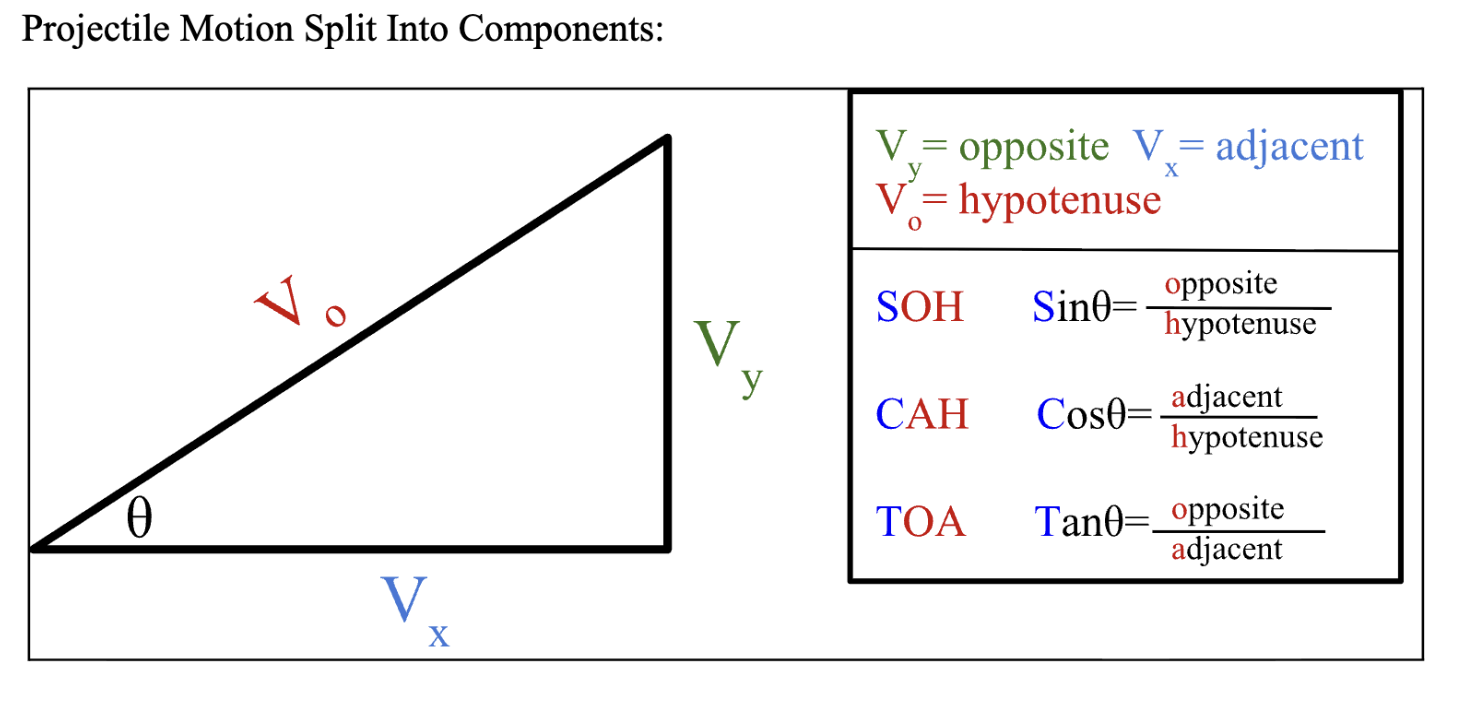
Projectile motion is the motion of an object thrown or projected into the air that is exposed only to acceleration due to gravity. * Note, during AP Physics 1 you will ignore the effects of air resistance in most scenarios. While these objects are in the air, they create a path called a trajectory, which can be broken into both horizontal and vertical components. An example of this is a cannonball launched at an angle of 30° above the ground. During its trajectory, the cannonball has an initial velocity angled 30° upwards, which can be broken into horizontal velocity (x-component) and vertical velocity (y-component). Lastly, an important thing to consider with projectile motion is that there is no horizontal acceleration on a projectile, and horizontal velocity remains constant. However, there is vertical acceleration downwards due to the force of gravity, meaning the vertical velocity will change. This is precisely why an object launched at an angle, such as our cannonball scenario, will have a trajectory shaped as a parabola. The constant horizontal velocity moves the ball forward at a steady rate, while gravity causes the vertical velocity to decrease on the way up, reach zero at the peak, then accelerate downwards
Horizontal (x) Equations:
-
\[ a_x = 0 \]
where \(a_x\) = horizontal acceleration
-
\[ v_x = v_{x0} \]
where \(v_x\) = final horizontal velocity, \(v_{x0}\) = initial horizontal velocity (remains constant)
-
\[ x = x_0 + v_{x0}\,t \]
where \(x\) = final horizontal position, \(x_0\) = initial horizontal position, \(v_{x0}\) = initial horizontal velocity, \(t\) = time
Vertical (y) Equations:
-
\[ a_y = g = -9.8\ \text{m/s}^2 \]
where \(a_y\) = vertical acceleration, \(g\) = gravity
-
\[ v_y = v_{y0} + g\,t \]
where \(v_y\) = final vertical velocity, \(v_{y0}\) = initial vertical velocity, \(g\) = gravity, \(t\) = time
-
\[ y = y_0 + v_{y0}\,t + \tfrac{1}{2}g\,t^2 \]
where \(y\) = final vertical position, \(y_0\) = initial vertical position, \(t\) = time, \(g\) = gravity
-
\[ v_y^2 = v_{y0}^2 + 2g(y - y_0) \]
where \(v_y\) = final vertical velocity, \(v_{y0}\) = initial vertical velocity, \(g\) = gravity, \(y\) = final vertical position, \(y_0\) = initial vertical position
Projectile Motion Split Into Components:
Free fall:
Free fall is when the only force on an object is gravity, and air resistance is negligible. The acceleration of an object in free fall is gravity (g), the force of gravity, which will cause an object to accelerate at -9.8 m/s2, which can be simplified to -10 m/s2 when solving. The acceleration of an object in free fall will always be gravity, -10 m/s2, even if the object is traveling upwards. The magnitude of acceleration will always be g regardless of the size or mass of the object.
Fun fact: if a car and a feather were dropped from the same height in a vacuum with no air resistance, they would both fall at the same rate and with the same acceleration of g. This is because the only force acting on both objects would be gravity, which causes all objects to accelerate at the same rate in free fall regardless of their mass.