Forces - How Objects Change Motion Through Interactions and Newtons Three laws
UNIT 2 Forces:
Forces are the interactions between objects that change their motion, energy, or shape. The simplest way to think of a force is as a push or a pull. A force is the result of an interaction between two objects. Now, forces can be described as a contact or non contact force. A contact being something like force of friction and a non contact being something strong force that holds subatomic particles together. For now lets not worry about all these types of forces, as youll learn about the basic ones on this page and others on later units like electricity and magnetism. Lastly, during this unit youll learn about different types of forces, force diagrams, vectors, newtons 3 laws, and how to solve equations. Forces are a very important unit that Will show up in later units, so make sure you understand them
Terms:
(F) Force - An interaction between two or more objects that causes a change in motion, energy or shape. Measured in Newtons (kg x m/s2).
\( F = ma \)
- \( F \) is the force (Newtons)
- \( m \) is the mass (kg)
- \( a \) is the acceleration (m/s²)
(M) Mass - The amount of matter in an object regardless of where it is located, measured in kilograms. *Note: Mass is not the same as an object's weight.
Weight - The force of gravity acting on an object, measured in newtons.
\( W = mg \)
- \( W \) is the weight (Newtons)
- \( m \) is the mass (kg)
- \( g \) is gravity (9.8 m/s²)
Newton's Laws of Motion
Newtons First Law (Law of Inertia) - Newtons first law states that an object at rest stays at rest and an object in motion stays in motion at a constant velocity unless acted upon by a net external force. This law is essential to the way that we think about forces and motion. It tells us that an object will remain at rest or at a constant velocity if there is no net force on it. However if there is a net force acting on it, the object will accelerate in the direction of the net force.
Newtons Second Law (Law of Acceleration) - Newtons second law of motion states that the acceleration of an object is directly proportional to the force acting on it.
\( F_{\text{net}} = ma \)
- \( F_{\text{net}} \) is the net force (Newtons)
- \( m \) is the mass (kilograms)
- \( a \) is the acceleration (m/s²)
This law is crucial to deriving the motion of objects and determining the acceleration on them and will be your best friend throughout this unit.
Newtons Third Law (Law of Action-Reaction) - Newtons third law states that for every action there is an equal and opposite reaction. What this law means is that when there is a force or action done on something there is an equal force acting back. This may sound strange and that's because it is not typically intuitive, so think of it like this. When you hit a ball with a bat, the ball is also hitting the bat. Or when if you hit a wall, the wall also hits you. This is why it would hurt if you punch a wall, or when you push water back with your arm as you swim it pushes you forward.
Types of Forces:
Gravitational Force (Fg) - The force between two objects due to their masses.
Frictional Force (FF) - The force that opposes the motion of an object sliding against a surface.
Normal Force (FN) - The force exerted by a surface perpendicular to it to support objects.
Force Tension (FT) - The force transmitted by a rope, string, or cable when it is pulled by forces acting on it.
Applied Force (FA) - The force directly applied to an object through a push or pull.
Force Drag (FD) - The force that opposes an object motion when traveling through a fluid.
Common Forces:
Gravity (Weight)
\( F_g = mg \)
- \( m \) = mass of object (kg)
- \( g \) = acceleration due to gravity (9.8 m/s²)
Normal Force
The normal force is the force that is perpendicular to the surface its on. The best way to think of the normal force is as a support force exerted by the surface a object is on to keep the block from going through that surface. If a block is on a flat surface, the normal force will be pointing upwards and be equal to the Fg, canceling out the forces and keeping the block from accelerating up or down. However, if the block is pushed down on a surface, the normal force will now be equal to the Fg plus the applied force to cancel out the forces and keep the block from accelerating up or down, meaning FN > Fg.
Friction (force that opposes motion)
\( F_f = \mu F_N \)
- \( \mu \) = coefficient of friction (depends on the surfaces in contact and is always < 1)
- \( F_N \) = normal force
Free body diagrams:
Free body diagrams are a way to represent forces acting on an object to easily determine the net forces exerted on them. Draw a box to represent the object or system, then draw arrow representing the forces acting upon it. The bigger a force is, the longer the arrow will be. Forces are represented by vectors showing the direction and magnitude of the force. If you do not know about or haven't learned about vectors, click on this link to learn about them first: Click Here
Examples:
Here are 4 different free body diagram examples with their forces labeled and the description of what is happening to the object.
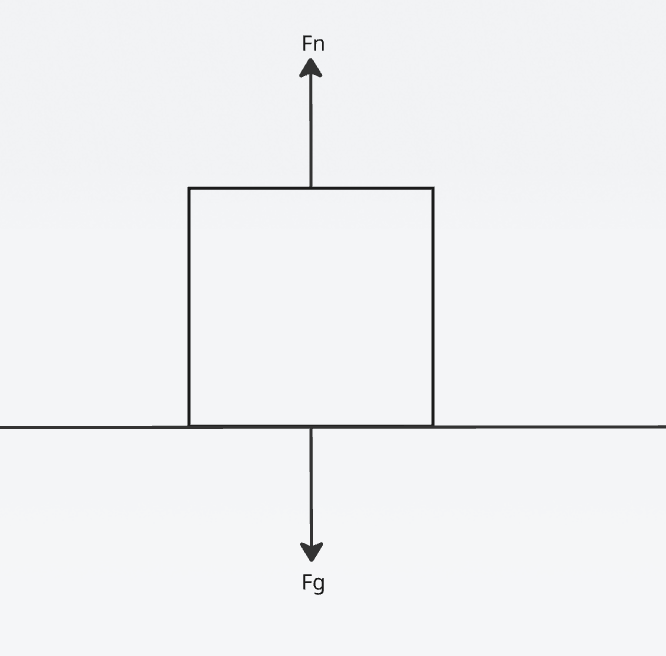
The FBD represents a object resting on a surface at rest. There are no forces acting on the side of the block, and the Fg is balanced by the FN, meaning there is no net force on this object
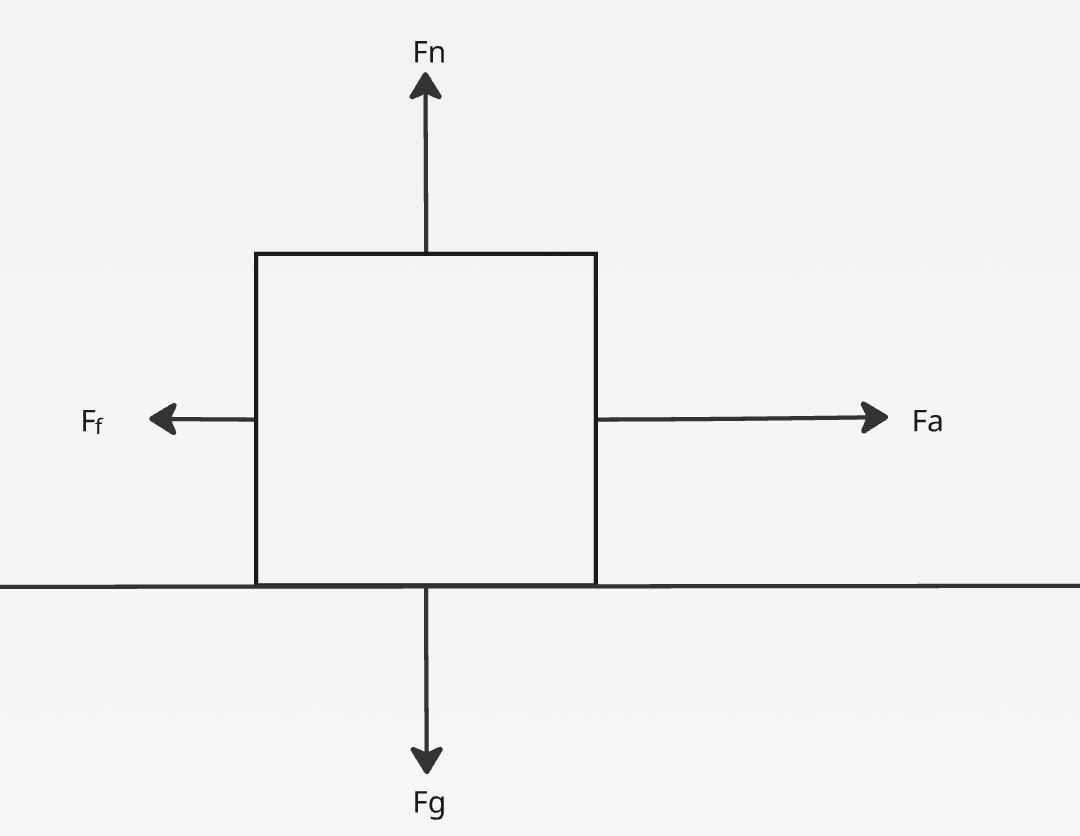
The FBD represents an object on a surface with an applied force to the right, and a frictional force to the left. The FN cancel with the Fg, but because the applied force to the right is much larger than the Ff to the left, the object has a net force and accelerates to the right.
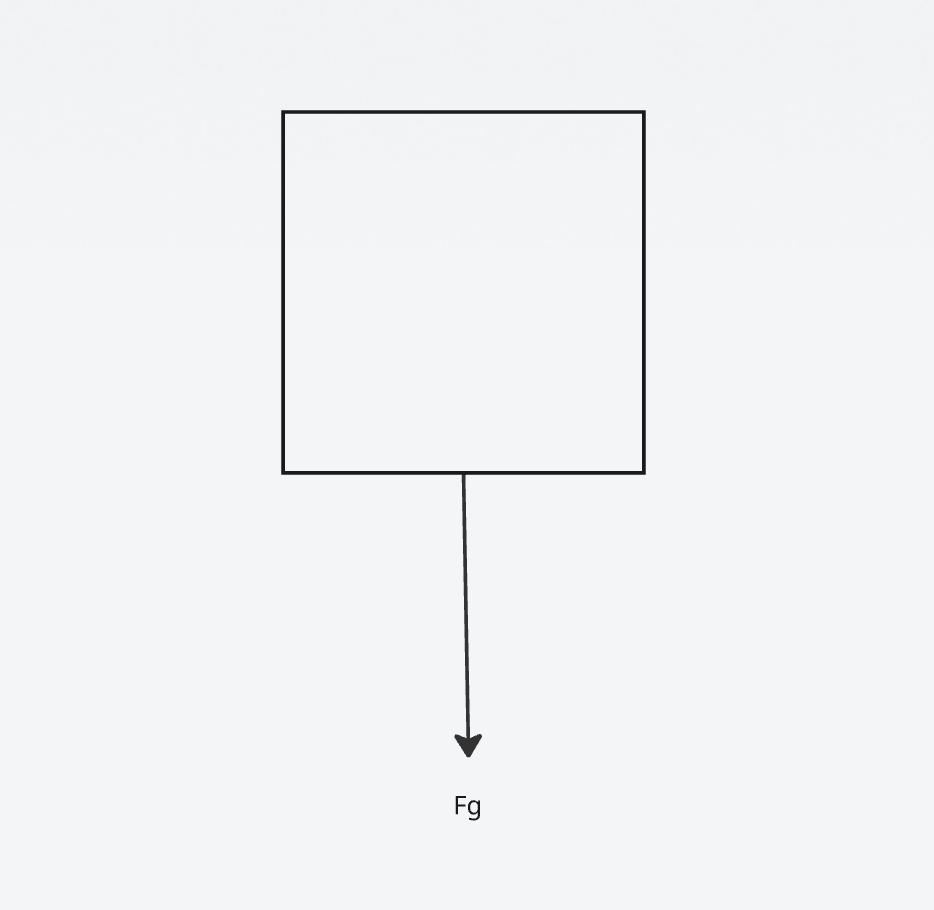
The FBD represents an object with one force acting on it, Fg. This situations represent an object in free fall ignoring the effect of air resistance.
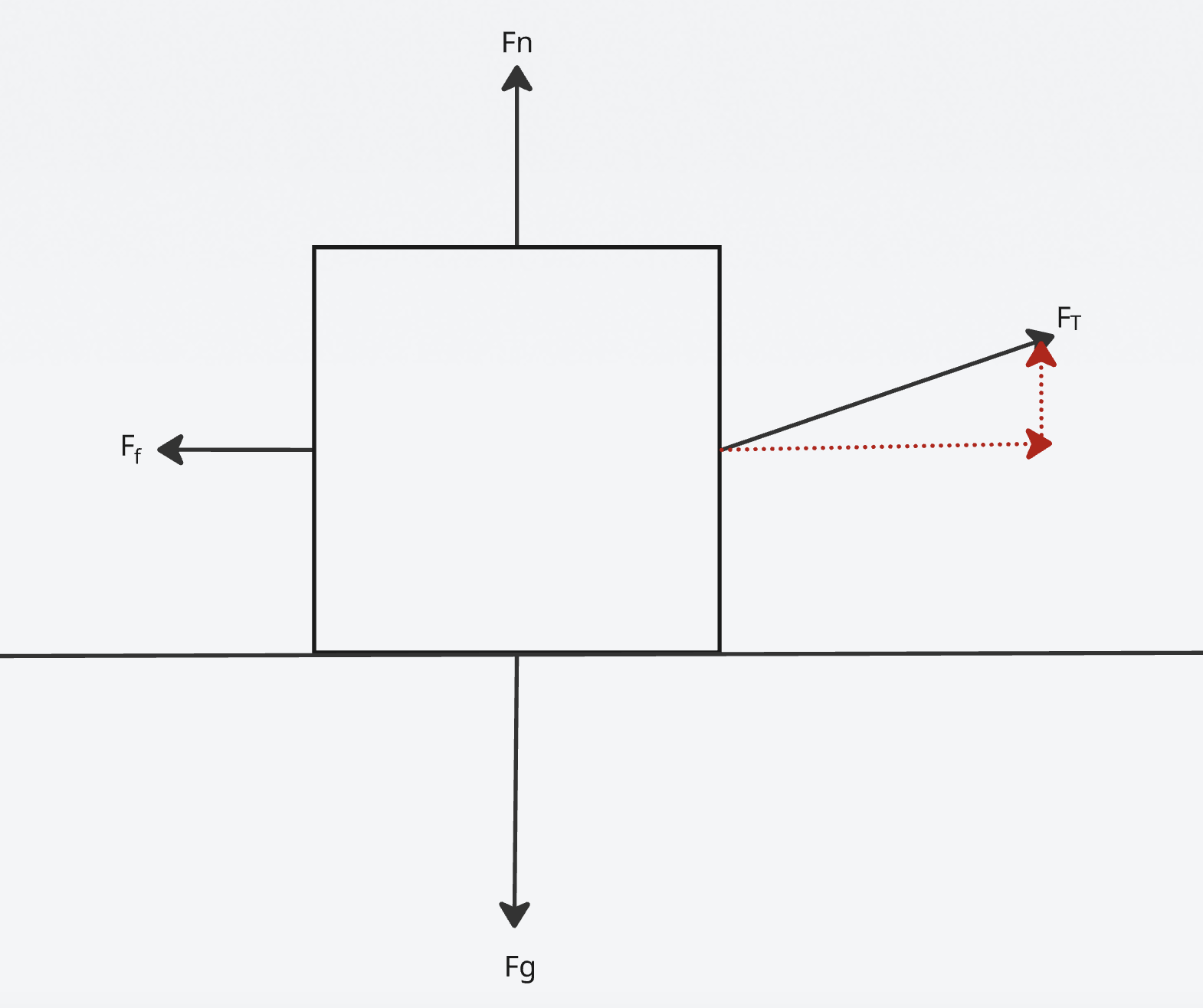
The FBD represents an object being pulled to the right on a surface with friction, but this time it is being pulled by a rope at an angle upwards. Notice how the FT is broken into vertical and horizontal parts. We can first figure out that the horizontal part of FT is greater than the frictional force, so the object accelerates to the right. Another important thing to see is that in this case, the FN is smaller than the Fg, but if you look closely, you will notice that the size of the vertical component of FT + FN is equal Fg, meaning that the upward and downward forces cancel out and the object only accelerates to the right.
- Read the question to understand what is being asked or what the situation is
- Draw a free body diagram or image of what is happening to the object or system and accurately label the forces *Make sure to represent the magnitude and direction of the forces correctly*
- Add or subtract the forces to find the net force (Fnet) on the object/system
- Use the equation Fnet = ma to solve for unknowns
Example Problem
1) A box of mass 20kg is inside of an elevator that is accelerating upwards at 5m/s2. A scale is placed underneath the box in the elevator. What is the reading on the scale in kg? *Hint: 1 Newton = 0.102 kg*
- First lets understand what is happening. A block of mass 20kg is accelerating upwards at 5 m/s2 inside a elevator.
- Next, we draw a free body diagram showing two forces: Fg pointing downwards and and a larger arrow representing FN pointing upwards.
-
\[ F_{\text{net}} = F_N - F_g \] \[ F_{\text{net}} = ma \] \[ ma = F_N - F_g \] \[ ma = F_N - mg \] \[ ma + mg = F_N \] \[ F_N = m(a + g) \] \[ F_N = 20\,\text{kg} \times ({\color{red}5\,\text{m/s}^2} + 9.8\,\text{m/s}^2) \] \[ F_N = 20\,\text{kg} \times 14.8\,\text{m/s}^2 \] \[ F_N = 296\,\text{N} \] \[ 296 \times 0.102\,\text{kg} = \boxed{30.2\,\text{kg}} \]
- Now we have gotten out answer. The scale inside the elevator will read about 30.2 kilograms on it!
Forces on Inclines:
When a object is on an incline, the forces acting on it are typically broken down into components due to the angle of the incline.
Here is how the forces are broken down on a FBD
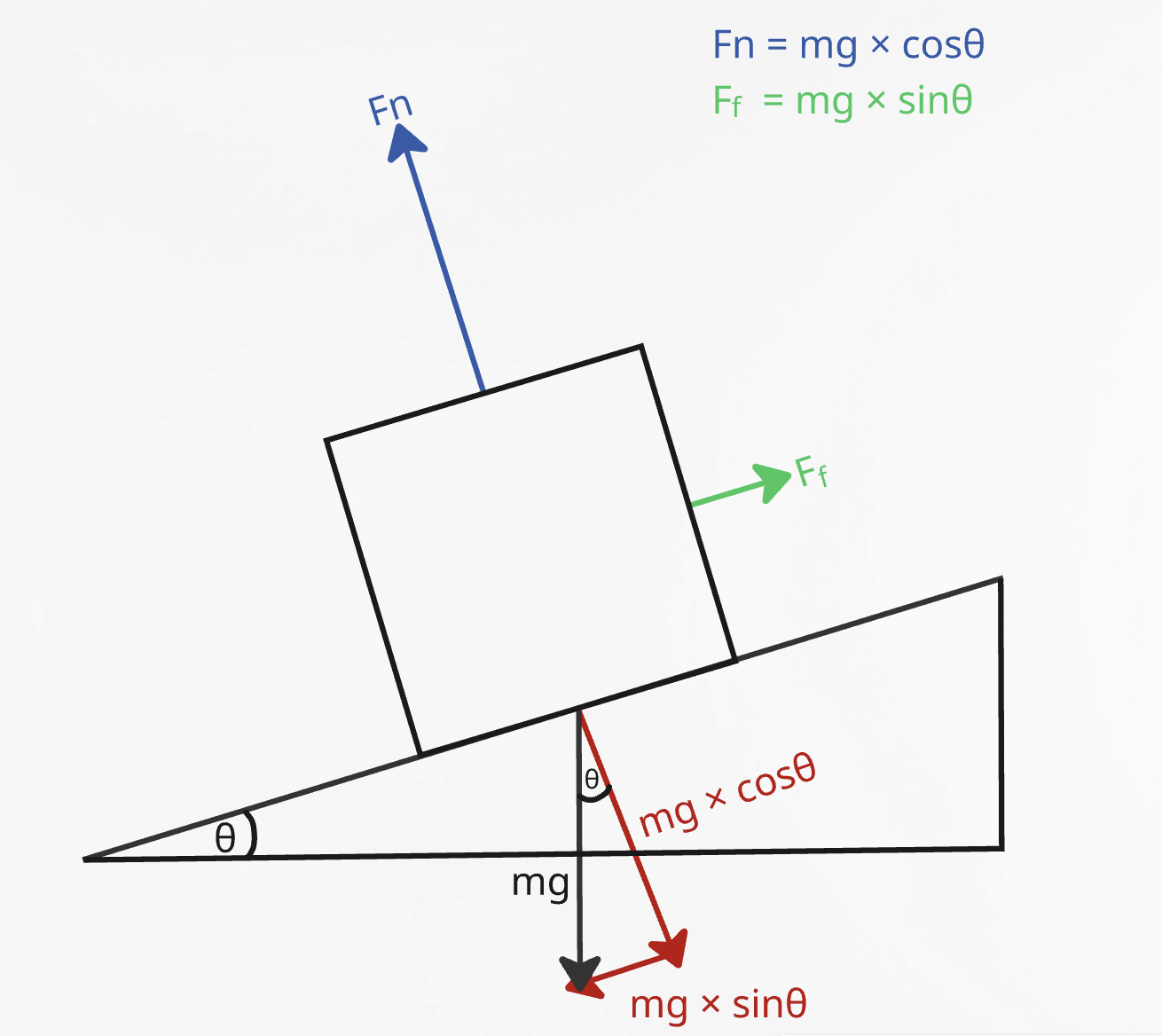
- Fg is still represent mg and is pointing downwards normally. However, since the block is at a incline, Fg is broken down into two components: Fg parallel to the incline [mg sinθ] and Fg perpendicular to the incline [mg cosθ].
- FN is the normal force, which is perpendicular to the surface of the incline and is equal to the component of Fg perpendicular to the incline [mg cosθ].
- Ff is the frictional force, which is parallel to the surface of the incline is equal to the component of Fg parallel to the incline [mg sinθ].
These forces all cancel each other out and represent a block at rest on an incline, the main force holding it on the incline is the frictional force, opposing the motion of the block down the ramp.
Practice Problems:
-
What do you know about an object that is being acted upon by balanced forces?
- It must be at rest
- It must be accelerating
- It must be moving at a constant velocity
- None of these could be true
- Two of these could be true
-
Mike slides a glass across the counter. When it leaves his hand and it is sliding, what forces are acting on the plate? Ignore air resistance.
- Gravity, normal force, and constant frictional force
- Gravity and normal force only
- Gravity, normal force, and force applied
- Force normal, frictional force, and applied force
-
A person is trying to lift a block of weight Fg with a force of FA but is not able to lift it off the floor. What is the ranking of the magnitudes of the forces acting on the block?
- FA + FN < Fg
- FA + FN = Fg
- FN = Fg
- FA + FN = Fg
-
A refirgerator is being pushed across the floor with a force of F. The weigth is 400 N, the normal force is 400 N, and the force of friction if 250 N. The refirgerator is acceleratig at 0.5 m/s2. What is the value of the force F most nearly to?
- 50 N
- 20 N
- 250 N
- 270 N
-
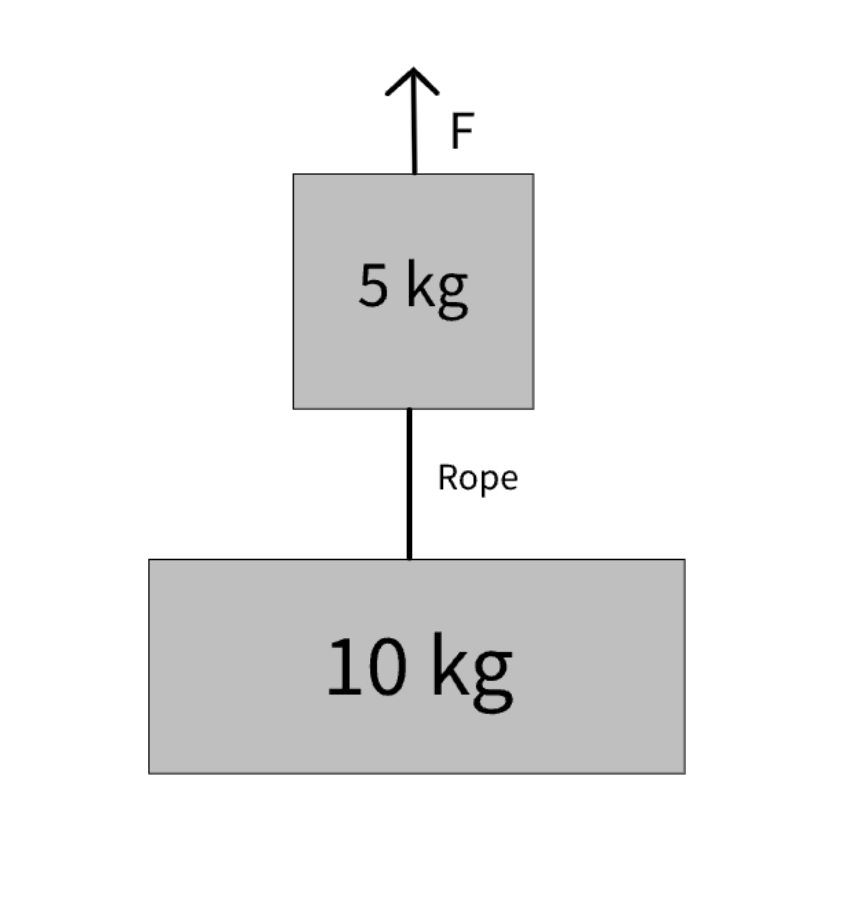 The two blocks shown are connected by a rope, the masses of the blocks are 5 kg (upper) and 10 kg (lower).
The magnitude of the applied force on the upper block is F directed upward. Answer the following questions:
The two blocks shown are connected by a rope, the masses of the blocks are 5 kg (upper) and 10 kg (lower).
The magnitude of the applied force on the upper block is F directed upward. Answer the following questions:
- If the blocks are both moving at a constant speed, what is the value of the force F?
- The system now accelerates upward at 2 m/s². What new value of F is required to produce this acceleration?
- Using the force F from part (B), what is the tension in the rope connecting the two blocks?
-
A block of mass m is pushed across a rough surface by an applied force of FA. FA is directed and an angle θ above the horizontal. The block experience a
frictinal force of Ff in the opposite direction of its motion. What is the coefficient of frction between the surface and the block?
- \( \frac{F_f}{mg} \)
- \( \frac{F_f}{F_A\cos\theta + mg} \)
- \( \frac{F_f}{F_A\sin\theta + mg} \)
- \( \frac{F_A\cos\theta}{mg} \)
-
Two blocks of mass M1 and M2 [M1 > M2] are connected by a string of nelgible mass hung over a pulley system. When the blocks are released,
what is the magnitude of the acceleration of the system equal to?
- \( \frac{g(M_1 -M_2)}{M_1 + M_2} \)
- \( \frac{g(M_2 - M_1)}{M_1 + M_2} \)
- \( {g(M_1)} \)
- \( \frac{g(M_1 + M_2)}{M_2 - M_1} \)
-
Free Response — Incline-Pulley System
A block of mass M = 5 kg rests on a frictionless incline at angle θ = 37° (sin 37° = 0.60, cos 37° = 0.80). It is connected by a light string over a frictionless pulley to a hanging block of mass m = 3 kg.- Draw and label a free body diagram for each block.
- Write Newton's second law equation for each block. Take the positive direction as: up the incline for M, downward for m.
- Find the acceleration of the system.
- Find the tension in the string.
- A rough surface is now introduced between M and the incline with coefficient of kinetic friction μk = 0.25. How does the acceleration change? (Recalculate.)
-
Free Response — Stacked Blocks
Block A (mass mA = 4 kg) rests on top of Block B (mass mB = 8 kg). Block B rests on a frictionless floor. The coefficient of static friction between A and B is μs = 0.30 and the coefficient of kinetic friction between A and B is μk = 0.20. A horizontal force F is applied to Block B only.- If F = 24 N, determine whether the blocks move together or slip. Justify your answer.
- Assuming the blocks move together in part (A), find the acceleration of the system and the friction force that Block B exerts on Block A.
- What is the maximum force F that can be applied to Block B before the blocks begin to slip?
- If F exceeds the value from part (C), find the acceleration of each block separately.
-
Free Response — Three-Block System
Three blocks are connected in a line on a frictionless horizontal surface. Their masses are m1 = 2 kg, m2 = 3 kg, and m3 = 5 kg (left to right). A horizontal force F = 40 N is applied to m1 directed to the right.- Find the acceleration of the entire system.
- Find the tension T12 in the string between m1 and m2.
- Find the tension T23 in the string between m2 and m3.
- Block m2 is now removed and m1 and m3 are directly connected. The same force F = 40 N is applied. How does the tension in the connecting string compare to T12 from part (B)? Explain conceptually.